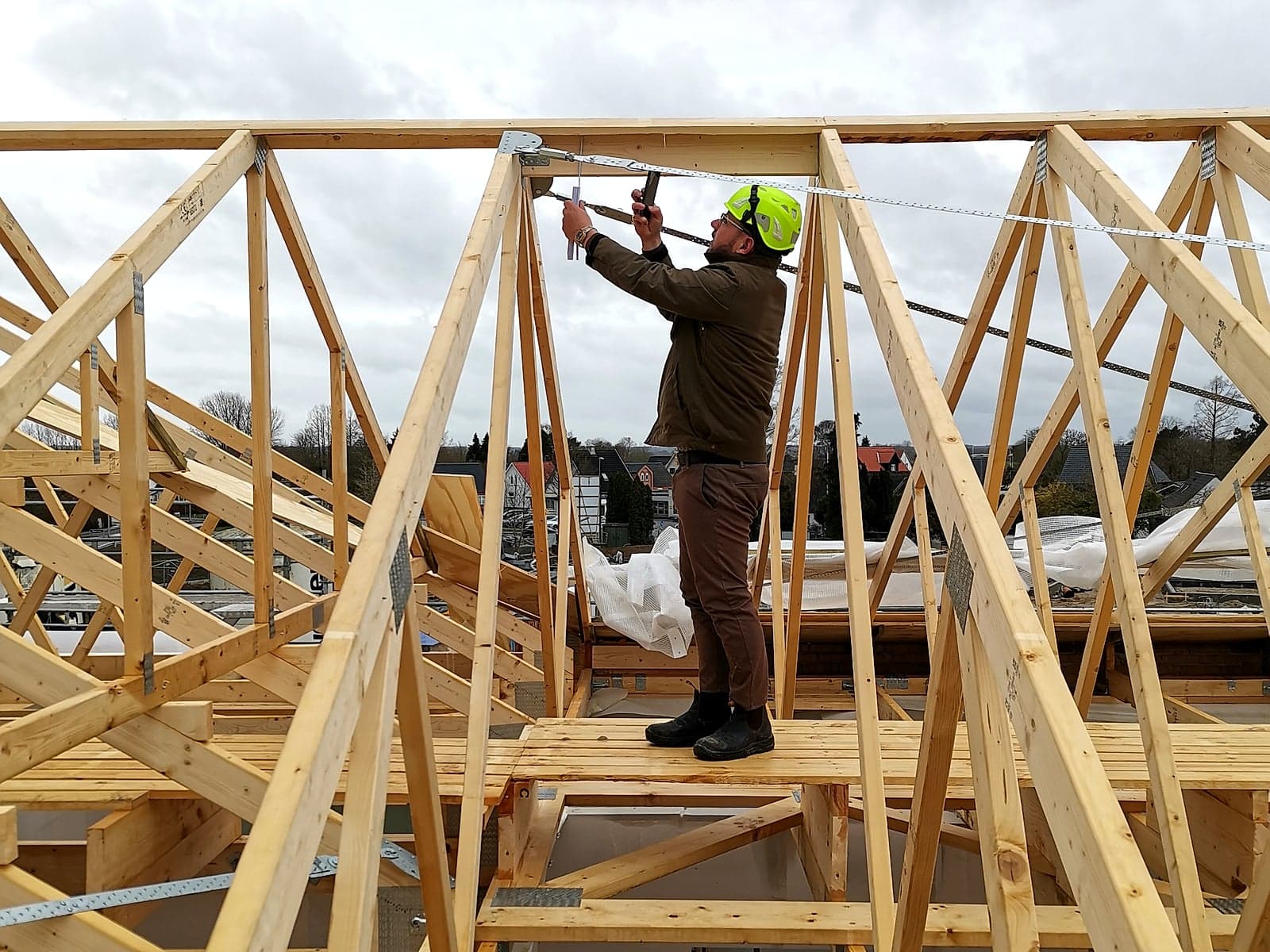
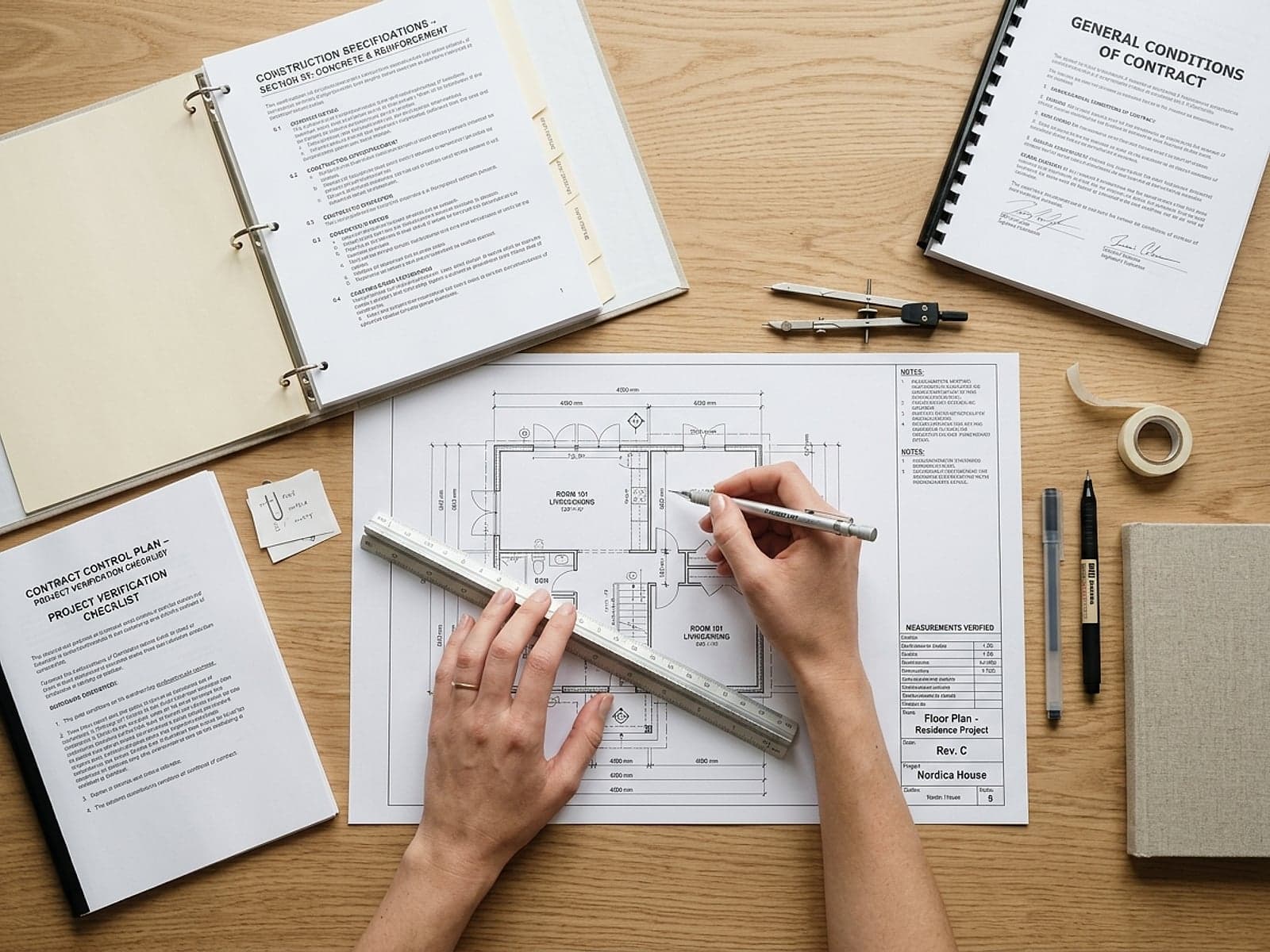
Documentation begins before construction
A significant part of the basis for the later construction project is already created in the tender and bid phase. Tender documents, bids, reservations, specifications, drawings, models and subsequent clarifications can all affect what the parties have actually agreed. What matters is not only keeping the documents, but knowing which documents apply and what they mean for the subsequent execution.
The contract basis – what have you actually agreed?
AB 18, ABT 18 and ABR 18 are standardised contract conditions – not law – which only apply when they have been agreed between the parties (§ 1(1)). Deviations only apply when the agreement clearly and expressly states the points on which it deviates (§ 1(2)). Before the contract is signed, you should have control of the applicable documents and their order of precedence, deviations, design responsibility and interfaces, revisions, changes, notification, control and documentation requirements, milestones and handover.
AB 18 § 6(3) (ABT 18 § 6(3)) sets an order of precedence between the contract documents in the event of conflict between them, but it does not resolve conflicts within the same type of document – for example between a drawing and a specification. It is therefore a good idea to agree a project-specific order of precedence.
A classic pitfall is to focus on price and scope but overlook provisions that shift risk, liability or the obligation to document.
The contract governs the relationship between the parties, but cannot in itself make a building lawful in the eyes of the authorities if the relevant public-law requirements are not met. Under the Danish Building Act (byggeloven § 17(1)), it is at all times the owner’s responsibility to rectify conditions that contravene building legislation.
So keep two questions separate
- Is the work technically correct and compliant with the authorities’ requirements?
- Who bears the contractual liability?
From project material to execution
Once construction starts, documentation becomes part of the practical management of the project. Drawings, specifications, models and technical instructions must be linked to the work actually being carried out. A piece of work can be correctly executed in terms of workmanship and still be wrong if it was carried out to an outdated revision.
Quality assurance must document the actual work
A standard checklist is a good starting point, but does not in itself document that the actual work has been carried out correctly. A useful check should show:
- what was checked
- which project basis it was checked against
- which acceptance criterion applied
- when the check was carried out
- what the result was
- who carried out the check
The goal is traceable documentation.
BR18 and documentation of load-bearing structures
For load-bearing structures, chapter 28 of BR18 sets specific documentation requirements, depending on the building’s structural class (KK1-KK4). The final documentation must be consistent with the finished building – including changes made during design and execution (BR18 § 494(3)).
The structural documentation consists of construction documentation (A1-A5, including A4 Structural changes (Konstruktionsændringer) and A5 Construction as built (Konstruktion som udført)) and project documentation (B1-B3, including B2 Structural control plan (Statisk kontrolplan) and B3 Structural control report (Statisk kontrolrapport) for both design and execution), cf. BR18 §§ 501-502.
DS 1140 and control of execution
For load-bearing structures, chapter 30 of BR18 (§§ 523-528) sets requirements for control of both the documentation and the execution. In structural class 1, only self-inspection is required; in structural classes 2-4, independent control is also required, and in structural class 4 third-party control as well.
Control must be carried out on the basis of adequate control plans, which are updated on an ongoing basis, and any deviations found must be dealt with (BR18 § 523).
BR18 § 527(6) refers to DS 1140, Execution of load-bearing structures – General control (Udførelse af bærende konstruktioner – Almen kontrol), when the control level for the general control of execution is to be determined. Special control, by contrast, is determined during design in accordance with DS/EN 1990 DK NA. Ordinary quality assurance and control under chapter 30 of BR18 and DS 1140 are therefore not automatically the same thing.
Changes must be traceable
It should be possible to trace a change:
- What was changed?
- Why?
- Who initiated the change?
- Which document was changed?
- Which revision now applies?
- Does the change affect time, cost or documentation?
Deviations must not just be recorded – they must be closed
A useful process follows these steps:
- Observation
- Requirement/reference
- Assessment
- Action
- Documentation
- Control
- Closure
A photo of a defect documents the observation, but not necessarily what happened afterwards.
At handover, the documentation must reflect the finished building
Depending on the project, the handover material may include quality assurance, control reports, tests, product and material documentation, as-built, structural documentation, fire documentation, O&M and recorded defects and remedial work. Documentation should be completed on an ongoing basis – not reconstructed just before handover.
In structural classes 2-4, the completion notice (færdigmelding) must include, among other things, the certified structural engineer’s final declaration and a declaration that the general control of execution has been carried out and deviations dealt with (BR18 §§ 41 and 499).
A defect must be both found and handled
It should be possible to document:
- what was found
- when
- which requirement is alleged to have been breached
- when and to whom the complaint was made
- what was agreed about remedying the defect
- whether the remedial work was checked
Under AB 18, the client calls an inspection no later than 1 year after handover and again before 5 years after handover (AB 18 §§ 56-57; ABT 18 §§ 54-55).
Five years is not automatically the same as limitation
Contractual liability periods, notice of defects and actual limitation must be kept separate:
- Notice of defects: A defect that becomes apparent after handover must be notified in writing within a reasonable time after it has been or should have been discovered (AB 18 § 49(2); ABT 18 § 47(2)).
- Liability period: Claims arising from defects must be made no later than 5 years after handover (AB 18 § 55; ABT 18 § 53). The time limit is absolute, but does not apply, among other cases, in the event of grossly irresponsible conduct, or if it is established at handover that agreed quality assurance has failed significantly.
- Limitation: The limitation period under the Danish Limitation Act is 3 years and runs at the earliest from when the defect was or should have been discovered – although limitation occurs no later than 10 years after the breach (Forældelsesloven §§ 2-3).
The specific contract, the notice of defects and the Limitation Act (Forældelsesloven) must be assessed together.
The practical documentation check
On a well-documented construction project, you should be able to answer the following at any time:
Documentation check
- What has been agreed?
- Which project material applies?
- Who designs what?
- Which checks are required?
- Which acceptance criteria apply?
- Is concealed work documented?
- Are changes and revisions recorded?
- Have deviations been dealt with and closed?
- Have the consequences for time and cost been handled?
- Does the final documentation match what was actually built?
Free PDF · 8 pages · 30 checkpoints
Free checklist – Construction documentation
Get KS Danmark’s practical checklist for checking documentation throughout the construction project – from the contract basis and project material to execution, changes and handover. The checklist contains 30 specific checkpoints with an explanation of why each point matters.
Download free checklist – PDF (in Danish)
Documentation is created while construction happens
The strongest documentation is normally created at the same time as the action it documents. A coherent documentation chain makes it possible to follow the construction:
- Requirement
- Agreement
- Design
- Execution
- Control
- Change
- Handover
General technical information. The specific construction project may require a separate legal or technical assessment, and contract conditions may have been deviated from in the individual contract.
Sources
- BR18 chapter 28 – Documentation of load-bearing structures (§§ 494-505)
- BR18 chapter 30 – Control of documentation for and execution of load-bearing structures (§§ 523-528)
- BR18 §§ 40-46 – Completion notice and taking into use (Færdigmelding og ibrugtagning)
- DS 1140:2019 Execution of load-bearing structures – General control (Danish Standards)
- AB 18 – General conditions for works and supplies in building and construction (Almindelige betingelser for arbejder og leverancer i bygge- og anlægsvirksomhed)
- ABT 18 – General conditions for design-build contracts (Almindelige betingelser for totalentreprise)
- ABR 18 – General conditions for technical consultancy and assistance (Almindelige bestemmelser for teknisk rådgivning og bistand)
- The Danish Limitation Act (Forældelsesloven – lov om forældelse af fordringer)
Technically reviewed by Kvalitetssikring Danmark ApS · Last reviewed October 9, 2026