Kvalitetssikring Danmark ApS
Quality assurance

Quality assurance in construction

Get quality assurance under control from start-up to handover

Quality assurance must be part of the construction process itself. It is not something that is only gathered together when the building is nearing handover.

Good quality assurance creates a clear link between what was agreed, what was designed, what was executed, what was inspected and the documentation that is handed over.

KS Danmark helps contractors, trade contractors, building owners and consultants bring structure to quality assurance: from the first requirements in the tender documents to inspection during execution, technical clarifications, final inspection, master review and handover.

Professionally reviewed by Jack Lynge / Kvalitetssikring Danmark ApS · Last professionally reviewed: October 28, 2026

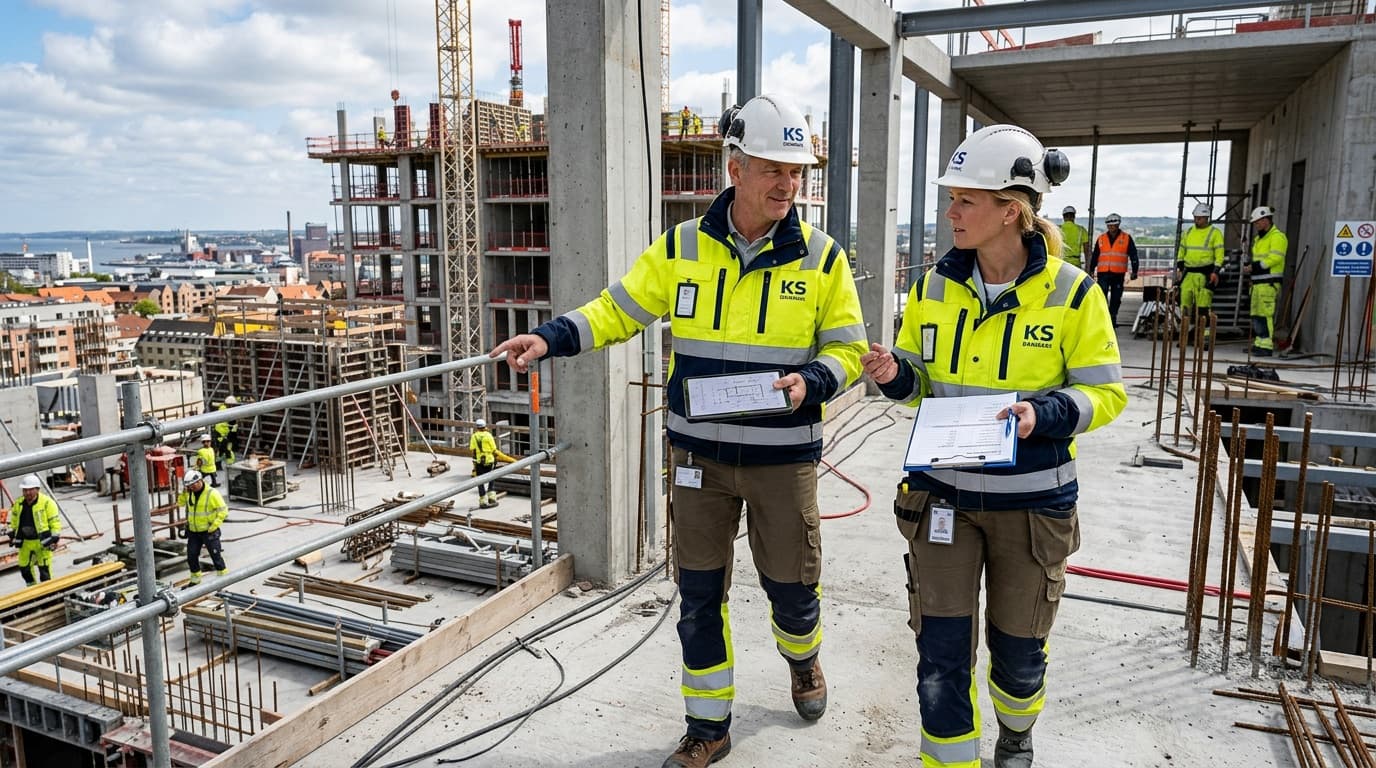
Project manager and site foreman from KS Danmark review completed work on a construction site

What is quality assurance in construction?

Quality assurance is fundamentally about ensuring and documenting that the work is carried out on the agreed and relevant basis.

Among other things, it can include the design and contract basis, control plans, receiving inspection, in-process inspection, dimensional inspection, photo and other documentation, product documentation, deviations, technical queries, final inspection, master review and handover material.

The scope depends on the specific construction project, the construction contract, the tender documents, the design documents and the requirements that apply to the work.

QA does not necessarily mean 100% inspection

Good quality assurance does not necessarily mean that 100% of all work carried out must be inspected and documented to the same extent.

The scope of inspection must be relevant to the work and follow the requirements of the project and the contract.

One challenge is that the inspection requirements in the tender documents are not always specific enough.

  • How much?
  • How often?
  • Where?
  • When?
  • How?
  • What documentation?

If this is not sufficiently clear, it should be clarified with the building owner (bygherre) or their consultant, so that a specific and documented basis is established.

The contractor should neither guess at a scope of inspection nor automatically interpret an imprecise requirement as a requirement for 100% inspection.

From tender control plan to your own quality assurance

The tender documents may contain requirements for the contractor's quality assurance and inspection. But the requirements are not always specific enough to be applied directly on site.

A requirement such as “The installation is inspected and documented” does not necessarily tell you, for example, how much must be inspected, where the inspection must be carried out, which acceptance criteria apply or how the result must be documented.

That is why the contractor should review the tender control plan (udbudskontrolplan) and the other requirements before execution.

  1. TENDER REQUIREMENTS
  2. ASSESSMENT
  3. CLARIFICATION WITH BUILDING OWNER/CONSULTANT
  4. AGREED SCOPE OF INSPECTION
  5. OWN CONTROL PLAN
  6. EXECUTION
  7. DOCUMENTATION

When the scope of inspection, method, acceptance basis or form of documentation is not sufficiently defined, the matter should be clarified and documented.

Quality assurance begins with those who carry out the work

A QA handbook or a digital system does not create quality assurance on its own.

The employees and tradespeople who carry out the work must understand: What must be inspected? Why? When? How must it be documented? What do we do if something does not add up?

A short start-up meeting between the project manager, the site foreman and the relevant tradespeople can create a far more secure foundation for quality assurance.

Among other things, the meeting should cover critical works, works that will later be concealed, dimensions and tolerances, receiving inspection, photo and measurement documentation, the scope of inspection and the handling of errors and deviations.

Professional quality assurance is not created in the office alone. It is created when the project management and those doing the work share the same understanding of what must be carried out, inspected and documented.

Receiving inspection: what are you taking over?

Receiving inspection is not only about materials and products delivered to the site.

It is also about the work and the working basis that one contractor takes over from another trade before starting its own work.

This could be, for example, the bricklayer taking over the foundation, the carpenter taking over masonry or concrete, the flooring contractor taking over the subfloor, or the painter taking over walls and ceilings.

Before the work continues, it should be assessed whether the work received is completed and suitable as a basis for the subsequent activity.

Among other things, this can include dimensions, levels, tolerances, surfaces, degree of completion, accessibility, clearing up and other necessary preconditions.

If the work received does not constitute a suitable basis, the matter should be recorded and notified in writing before your own work continues.

  1. What is the problem?
  2. Where is it?
  3. What significance does it have?
  4. What must be clarified or remedied?

If the work continues without reservation regarding visible or ascertainable conditions, this may, depending on the circumstances, have significance in a later assessment of errors, defects and liability.

Receiving inspection is therefore also the contractor's opportunity to document: “This was the working basis we took over.”

  1. RECEIVE
  2. INSPECT
  3. RECORD ANY RESERVATIONS
  4. CONTINUE

In-process inspection: inspect while the work can still be inspected

Some works cannot be properly inspected once the building is finished.

That is why relevant inspections must be carried out at the time when the work is still accessible. This applies in particular to works that will later be concealed, covered, built in, closed up or difficult to inspect.

In-process inspection can include, for example, execution conditions, positions, dimensions, tolerances, materials, joints, substrates and installation conditions.

500 photos are not necessarily good QA

A photo can be important documentation. But 500 unsorted photos do not necessarily document what was inspected, where, against which requirement, according to which drawing/revision, by whom and with what result.

Good quality assurance must create traceability:

  1. REQUIREMENT
  2. EXECUTION
  3. INSPECTION
  4. RESULT
  5. DOCUMENTATION

A good QA record should be able to answer six simple questions:

  1. WHAT?
  2. WHERE?
  3. AGAINST WHAT?
  4. WHEN/WHO?
  5. RESULT?
  6. DOCUMENTATION?

Deviations and technical queries

On a construction project, situations continually arise where what was designed, what was described and the actual conditions on site do not fit together completely.

What matters is not that questions or deviations never arise. What matters is how they are recorded, clarified and concluded.

A deviation can arise, for example, when the work executed does not correspond to the design documents, a tolerance cannot be met, a change of material is requested, the actual conditions differ from the design, or a planned solution cannot be carried out as described.

A photo and the text “deviation found” is not a closed case.

  1. FINDING
  2. RECORDING
  3. ASSESSMENT
  4. DECISION
  5. REMEDY/EXECUTION
  6. INSPECTION
  7. CLOSURE

Afterwards, it must be possible to understand: What was the problem? What was decided? Who made or confirmed the decision? What was carried out? How was the case closed?

Technical queries: ask before you build on

If the design documents are unclear, contradictory or do not provide a sufficient basis for execution, a technical query (RFI) can be an important management tool.

Instead of guessing or choosing a design solution yourself, the problem is described and sent to the relevant party with the authority to decide.

A good technical query should make clear: What is the question? Where is the issue located? Which design documents does it concern? What prevents or affects further execution? What clarification is needed?

Drawing reference, revision, location and relevant photo documentation should be included where relevant.

A verbal message on site can solve the problem today, but be difficult to document six months later. That is why it is of great value that significant technical clarifications and changes are confirmed in writing and linked to the specific issue.

  1. QUESTION
  2. CLARIFICATION
  3. CONFIRMATION
  4. EXECUTION

At the same time, a technical query must not be used to make the contractor take over a design responsibility that lies with others. The contractor describes the problem and requests the necessary clarification from the party that has the authority to make the decision.

  1. OPEN
  2. RESPONSIBLE
  3. RESPONSE DEADLINE
  4. ANSWERED
  5. IMPLEMENTED
  6. CLOSED
A question is not clarified because it has been asked. A deviation is not closed because it has been recorded. The value arises when the matter is assessed, the decision is confirmed, it is implemented and the case can be closed with documentation.

Ongoing QA can also affect payment

Quality assurance is not necessarily something that only has to be handed over when the building is completed.

The construction contract and the tender documents may require certain QA documentation to be delivered on an ongoing basis or in connection with the contractor's payment applications.

Missing agreed documentation may therefore, depending on the circumstances, affect the processing of an on-account payment application (acontoanmodning).

That is why you should clarify as early as project start-up:

  1. WHAT MUST BE HANDED OVER?
  2. WHEN?
  3. TO WHAT EXTENT?
  4. IN WHAT FORM?
  5. TO WHOM?

That is far better than discovering only at an on-account payment application or at handover that the documentation does not correspond to what was agreed.

Final inspection: document the condition before notifying completion

Final inspection is the contractor's concluding inspection of its own work before it is notified as complete.

It should not only check whether the work is finished. It can also be important documentation of the actual condition of the work at a specific point in time.

It should state, for example, whether the work is completed, whether there are visible errors or damage, whether relevant finishes are documented, whether any work remains, and when the inspection was carried out.

After notification of completion, other trades may gain access to the area and continue working around or on the finished work. If damage is found later, a dated and traceable final inspection can therefore be important in assessing when the damage may have occurred.

The final inspection is not in itself conclusive proof of who caused later damage. But it can document the recorded condition at the time of notification of completion.

RECEIVING INSPECTION
What did we take over?
IN-PROCESS INSPECTION
How did we carry out and document the work?
FINAL INSPECTION
What did we notify as complete, and what condition was it in?

Master review: find the defects before the building owner does

Before any pre-handover or the formal handover, the contractor should carry out a systematic master review (mestergennemgang) of its own work.

The master review is not the same as the final inspection.

The final inspection documents the finished work and its condition. The master review is used actively to find your own errors, defects and remaining works before the building owner or their consultant carries out their review.

FIND AND REMEDY AS MUCH AS POSSIBLE BEFORE HANDOVER.

A thorough master review can help reduce the subsequent defects list and make the remaining defect remedies more manageable to complete within the set deadline.

  1. COMPLETE
  2. MASTER REVIEW
  3. REMEDY
  4. HAND OVER

That is both quality assurance and good construction management.

Have you fallen behind with your QA?

It happens on many construction projects.

The problem grows the longer the work continues, because parts of the execution can become concealed or difficult to document afterwards.

KS Danmark can help you get an overview:

  1. WHAT IS AVAILABLE?
  2. WHAT IS MISSING?
  3. WHAT CAN STILL BE DOCUMENTED?
  4. WHICH DEVIATIONS AND QUERIES ARE STILL OPEN?
  5. WHAT MUST BE IN PLACE BEFORE HANDOVER?

Who do we help?

  • TRADE CONTRACTOR

    “We need to get our QA and documentation in place.”

  • MAIN/DESIGN-BUILD CONTRACTOR

    “We need to keep track of both our own and our subcontractors' documentation.”

  • BUILDING OWNER

    “We need to be able to follow whether the agreed quality assurance is carried out and handed over.”

  • CONSULTANT/CONSTRUCTION MANAGEMENT

    “We need to be able to follow quality, inspection, deviations, technical clarifications and documentation during execution.”

DS1140

Quality assurance and DS1140 are not the same

General quality assurance of the building work and inspection of load-bearing structures under DS1140 must not be mixed up.

For load-bearing structures, a separate inspection and documentation basis applies.

If you work with a B2 control plan, a B3 control report, A5 as built, self-inspection or independent inspection, you can go on to KS Danmark's separate DS1140 section.

Quality assurance should make construction easier, not create more administration

Good quality assurance is not about producing as many documents or taking as many photos as possible.

It is about having the right inspection, the right communication and the right documentation at the right time.

So that afterwards you can document:

  1. What did we take over?
  2. What did we carry out?
  3. What did we inspect?
  4. Which deviations or questions arose?
  5. What was decided, and by whom?
  6. How were the issues concluded?
  7. What condition was the work in at notification of completion?
  8. What was handed over?

That is the core of professional quality assurance.

Do you need help?

KS Danmark helps bring structure to quality assurance, at start-up, during execution and when the documentation has fallen behind.

Professional basis and reservations

Requirements for quality assurance depend on the specific contract, the contractual basis, the tender documents, the design documents and the work being carried out.

The content on this page is general professional guidance and does not replace a specific assessment of the individual construction project, construction contract or design issue.

Where inspection requirements, responsibility, scope or documentation requirements are unclear, the matter should be clarified with the relevant party and documented.

Sources

Professionally reviewed by Jack Lynge / Kvalitetssikring Danmark ApS · Last professionally reviewed: October 28, 2026

Rights

© Kvalitetssikring Danmark ApS. All rights reserved.

KS Danmark's own tools, structures, help texts, inspection models and graphical presentations may not be copied, reproduced or used commercially without written permission, to the extent that the material is protected by copyright or otherwise legally protected.